Why Does Nobody Reapply Their Sunscreen?
SPF 50 on the label, SPF who-knows on your face by lunchtime. We went through the research on why sunscreen fails in real life — and found a Korean lab that stopped trying to fix the cream.
By KNS Uncles ·
Prologue
People have been fighting the sun for as long as they have had skin to lose to it. Veils, parasols, wide-brimmed hats, long sleeves in the hottest months of the year — for most of history, sun protection was something you wore. Sunscreen as we know it is young by comparison. It became a consumer product only in the twentieth century, and the number we all read on the bottle, the SPF, owes much to an Austrian chemist named Franz Greiter, who helped popularise the scale.
In a few decades, the cream won. It is now the default answer to the sun on every continent, and the most recommended skincare product dermatologists have. Every serious beauty brand sells one. Every bathroom cabinet has one.
So here is the uncomfortable question: if sunscreen is so universal, why does it so often fail the people wearing it? The label says SPF 50. The instructions say reapply every two hours. Is anyone actually getting what the bottle promises?
The Fact Check
We went looking for evidence, not opinions. Here is what the research says.
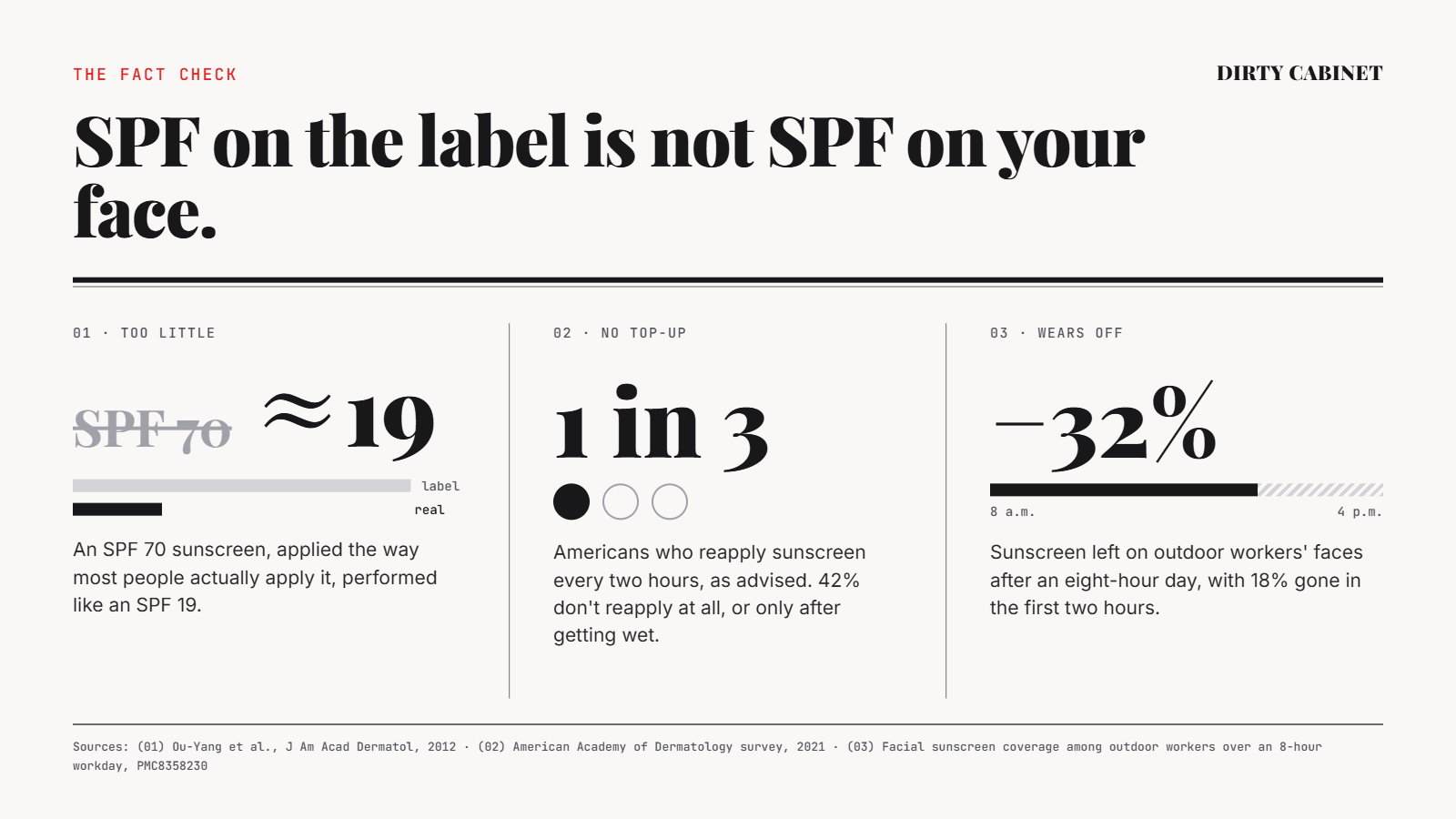
Most people apply far too little. SPF is measured in the lab at a fixed thickness — 2 mg of product per square centimetre of skin. Real users put on roughly a quarter to a half of that. In one study of six sunscreens labelled SPF 30 to 100, products applied at the typical consumer amount delivered a fraction of their rating: an SPF 70 performed like an SPF 19, and an SPF 100 like an SPF 27.
Almost nobody reapplies. A survey by the American Academy of Dermatology found that 80% of Americans know they should reapply every two hours, but only a third actually do — and 42% either never reapply or do so only after getting wet. Among adults skiing at high altitude, where UV is brutal, just one in five reapplied after two hours.
What you do apply wears off. A study that tracked sunscreen on the faces of outdoor workers across an eight-hour day found coverage dropped by about 18% in the first two hours alone, and by roughly 32% by the end of the day. The researchers concluded that after four hours, what's left may not be enough to protect the skin. Sweat makes it worse: in another study, an SPF 50 water-resistant sunscreen held its rating for six hours on people sitting still, but slid to around SPF 30 after six hours of sweating.
None of this means sunscreen doesn't work. It works very well — at the right amount, reapplied on time, on skin that isn't sweating, rubbing or under makeup. The problem is that this describes almost nobody's actual day. Especially not in a Gulf summer, on a golf course, or on a commute through forty-degree heat.
What Korea Did About It
Korea, the market that turned daily sunscreen into a national habit, reached the same conclusion a few years ago — and started making things you stick on instead of rub in. Sun patches, thin films worn on the parts of the face that take the most sun, became a domestic trend, with brands from IOPE to Mediheal launching their own. Golfers adopted them first; then commuters; then everyone.
Most of these patches are cooling hydrogel stickers with UV filters. One of them came from somewhere very different: a university lab.
Franz is the consumer brand of Biosensor Laboratories, a research company that grew out of the Institute of Molecular Biology & Genetics at Seoul National University. The name itself is a statement of intent: it is reported to honour Thomas J. Franz, the American scientist behind the Franz diffusion cell, still the standard instrument for measuring how ingredients pass into skin. The company holds 14 patents across four countries and publishes in SCIE-indexed journals. Its CEO came from McKinsey and Samsung Electronics, its CTO from the Samsung Advanced Institute of Technology, and its advisors include a former Pfizer and GSK bioinformatician and a skin-cancer physician in California. The house rule, translated from Korean: if it isn't proven, we don't make it.
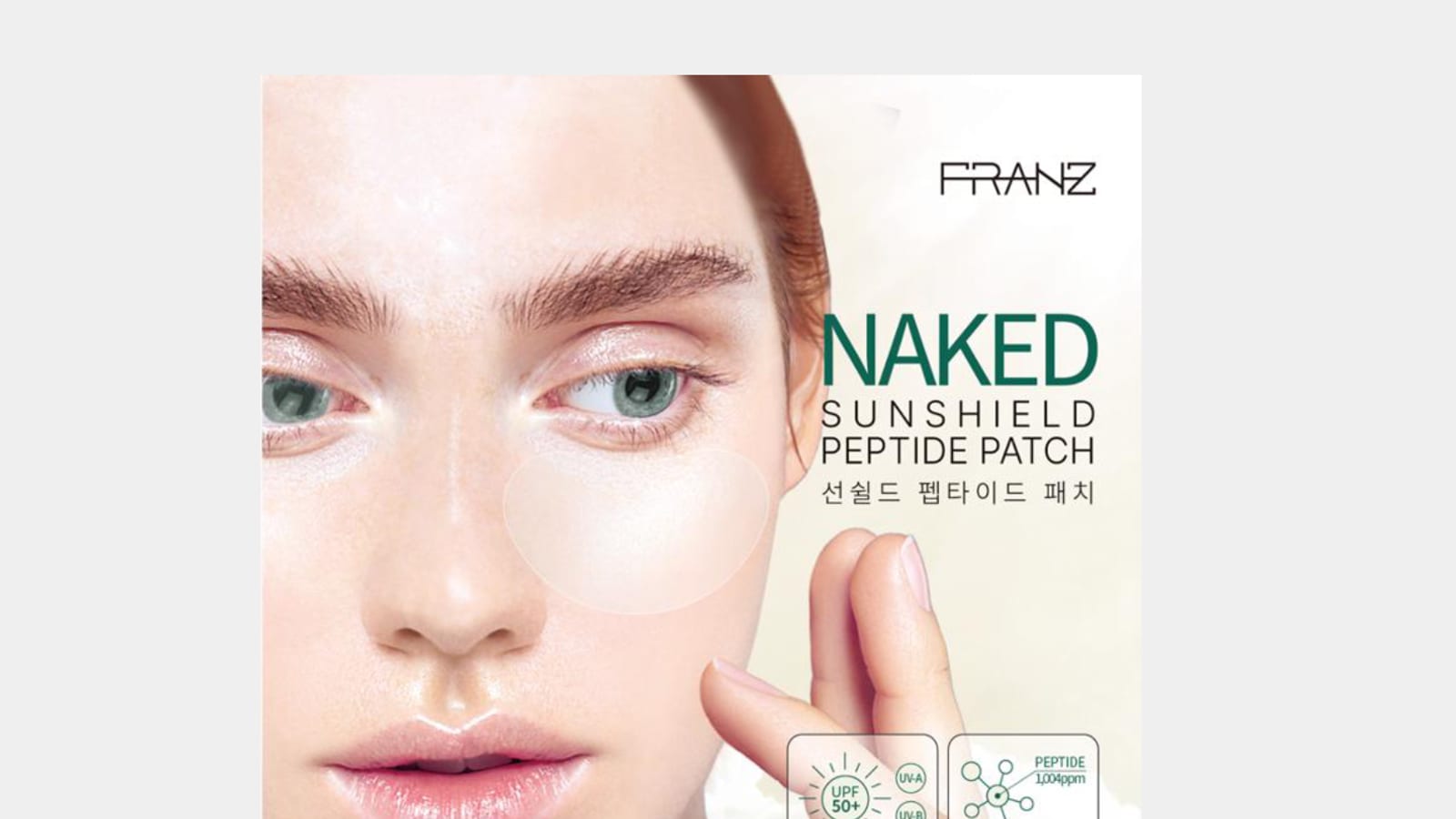
Their answer to the sunscreen problem is the Naked Sunshield Peptide Patch. Then we asked it the questions we'd ask any product we put our name next to.
What is it?
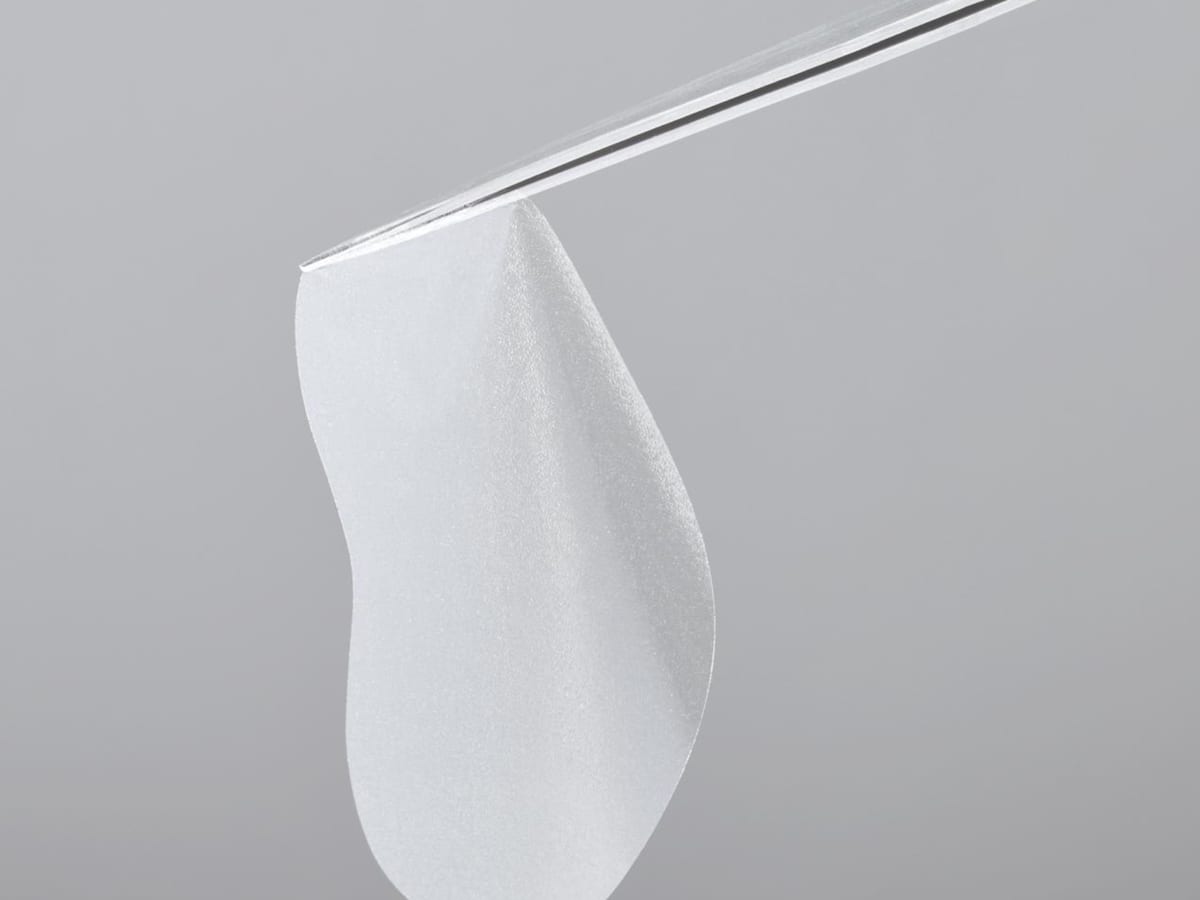
An ultra-thin, transparent, breathable patch that you press onto your cheeks and cheekbones in the morning. It blocks 99.9% of UVB and 98.1% of UVA, with a UPF 50+ rating — the same grade used for sun-protective clothing. Two to three minutes after you put it on, makeup can go over the top. At night it lifts off with water.
Why does it work?
Because it removes the three failure points from the fact check. There is no "amount" to get wrong — the film is the film. There is nothing to reapply. And it doesn't thin out with sweat or rub off under foundation the way a cream does. Protection is physical and stays where you put it.
Who is it for?
Anyone whose day doesn't allow reapplication: outdoor workers, drivers, golfers and runners, people who wear full makeup, and anyone living with strong year-round sun. It also suits people worried about pigmentation on the cheekbones, the area that takes the hardest hit.
How is it different from other sun patches?
Most sun patches are just shields. Franz built this one as a treatment too: the patch carries a four-peptide formulation with hyaluronic acid, and a Step 2 boosting essence goes on top. In clinical tests commissioned by the brand and run by P&K Skin Research Center, two weeks of use showed improvements in UV-irritated skin, pigmentation and sagging around the eyes. It also blocks more UVA than many hydrogel patches on the market, some of which stop at around 94%.
Why did we choose to write about this brand?
Three reasons. It solves a real problem, not a cosmetic one — and that problem is sharpest in the markets we work in. The evidence chain runs all the way from university lab to patent to journal to clinic to international award: in 2023 it was named a Promising Innovative Player at the IMCAS Innovation Tank in Paris. And it already sells, from Korea's biggest beauty chain to American retail shelves — so a new market isn't the first to take the bet.
The catch?
A patch protects the skin under it and nothing else. Your forehead, nose and jaw still need sunscreen — even the category's own advocates say patches work best alongside a regular SPF, a hat and clothing. Application takes a little practice; some first-time users say the films fold or stick to themselves. And per wear, it costs more than a dab of cream: in Korea, the Costco pack works out to roughly 1,100 won a pair, while US retail runs around $22 for four pairs. Finally, the Costco and TJ Maxx versions ship without the boosting essence, so it's worth checking which box you are buying.
Patch for the High Zones, Cream for the Rest
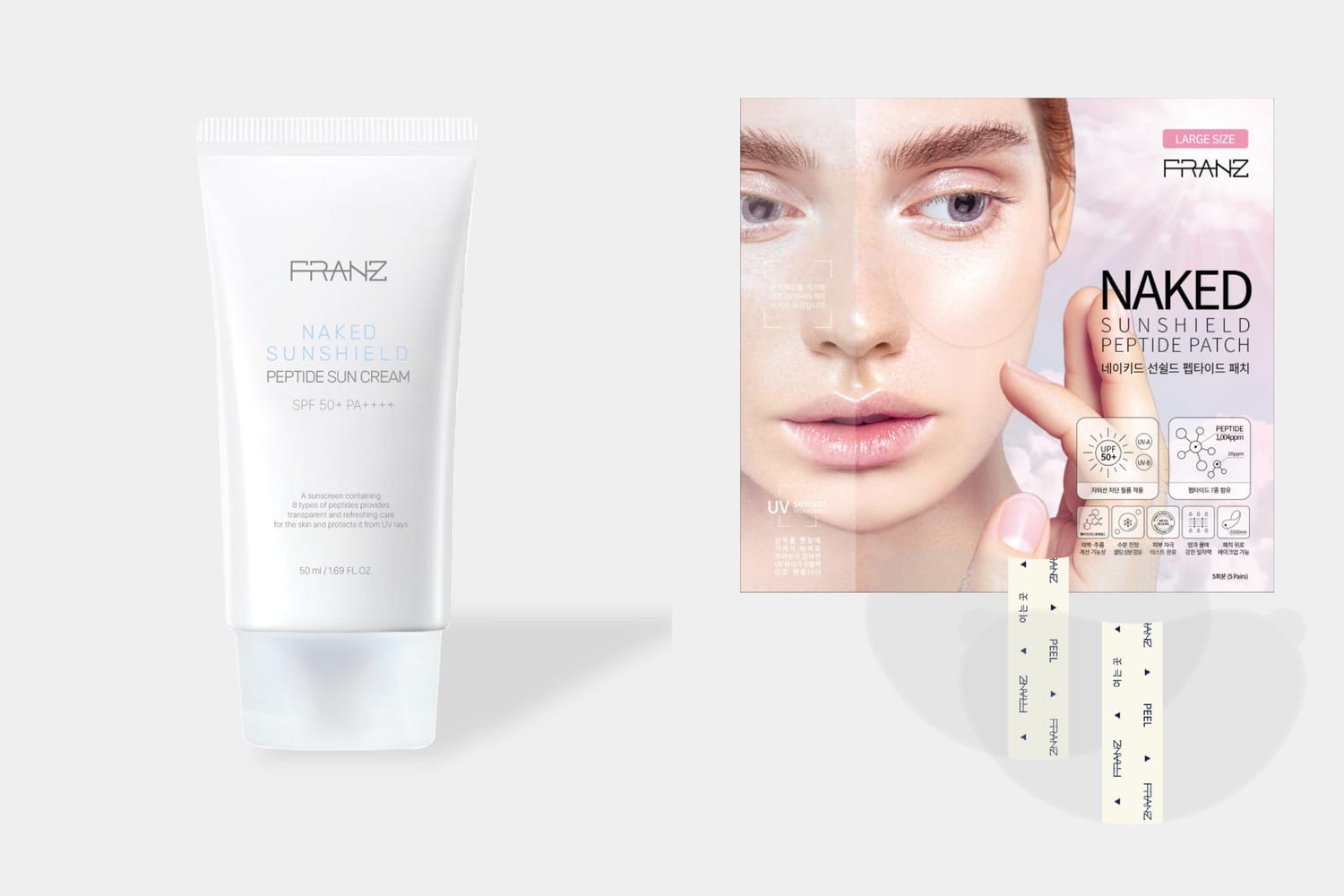
The patch was never meant to replace sunscreen, and Franz doesn't pretend it does. The same lab makes a peptide sun cream for everything the patch doesn't cover — forehead, nose, jaw. The routine is simple: cream all over in the morning, patches on the cheekbones, and nothing to reapply for the rest of the day.
Epilogue
For about eighty years, the beauty industry's answer to the sun has been a better cream. Lighter, more water-resistant, nicer to reapply. The research says the cream was never really the weak point — we were. Franz is what happens when a group of scientists accepts that, and designs around how people actually live. That is why it is the first thing we put in the cabinet.
Sources
- Ou-Yang H. et al., actual SPF of high-SPF sunscreens at consumer application amounts, J Am Acad Dermatol (2012)
- American Academy of Dermatology survey on sunscreen use (2021)
- Sunscreen compliance among adults at high-elevation ski areas
- Facial sunscreen coverage over an 8-hour workday among outdoor workers
- Sunscreen efficacy over time with and without sweating (hybrid diffuse reflectance spectroscopy)
- K-beauty sun patch trend, CosmeticsDesign-Asia (2023)
- Franz Naked SunShield Peptide Patch, CosmeticsDesign-Asia (2024)
- Costco Korea product listing
- Biosensor Laboratories / FRANZ Brand Deck (2025)